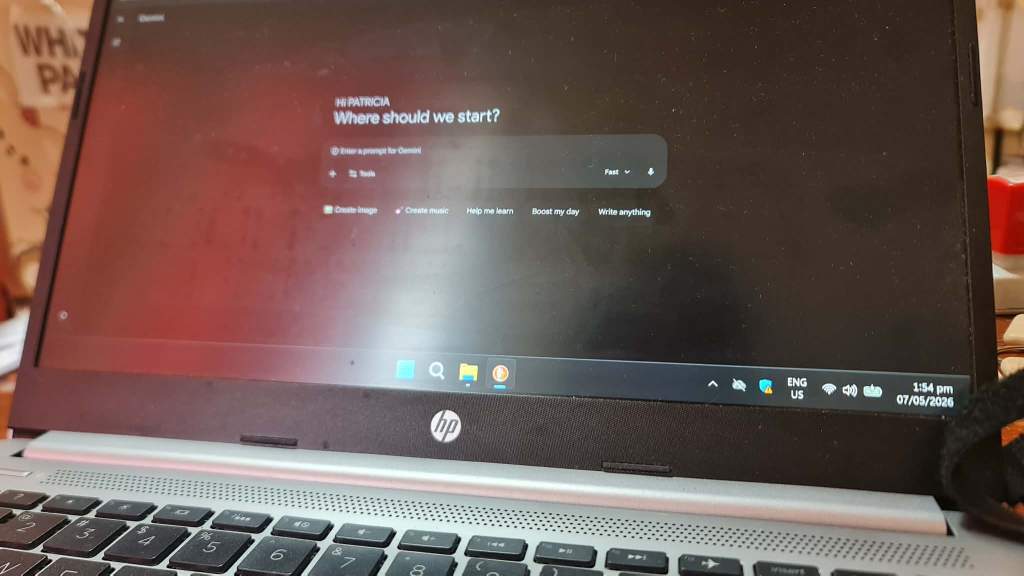
Apologies in advance. This post isn’t going to be about motherhood. This is me contemplating the future of this mom blog in the time of AI (artificial intelligence).
As I type this, I’m also reading articles on how to prevent AI from scraping my blog and stealing not just my writing style, but my thoughts and my experiences and my fears. But since I cannot, for the life of me, program, I have to accept the sad reality.
I have wanted to be a novelist since I was a child, but my family didn’t think I was talented enough to check creative writing in my college application form. The closest I got to pursuing this dream was writing Hey! Say! JUMP fan fictions on Crunchyroll and LiveJournal back when I was a jobless bum. Then true life happened.
Fast forward. A few years back, I took on side gigs as a blog writer for a handful of websites. A couple of employers encouraged me to use ChatGPT, and I did, and at the time, I felt like I was cheating the system. The pay was not high, mind you, and that was OK for me – I knew I wasn’t putting much effort anyway. The writing was not particularly impressive. I got paid for every article created by AI, humanized by AI, edited by AI for the specific purpose of being crawled by AI and pushed to the top of Google search.
At that time, I didn’t have feelings against generative AI yet; the strongest I felt was guilt for being paid by these foreigners to basically think of prompts. I was also able to separate my personal writing from AI-assisted writing, and I won four children’s writing awards without letting generative AI touch my stories. But the more I used ChatGPT, the more I felt the irritating temptation of copying my employers’ business model and use generative AI for “personal” blogging. Thankfully though, I stopped myself. I also stopped dreaming of ever monetizing my blog.
See, I don’t hate all AI. Like many, I welcome any opportunity to make tasks easier. I like, no – I want AI for some things: for folding laundry, for washing the dishes, for checking the exact calories I consume and burn. You know, things that I don’t like doing. Things that take away my brain cells and energy from what matters. But where do I draw the line? Jobs.
As I said, my original dream is to become a novelist. By using AI, we are allowing the theft not just of ideas and styles of authors and artists, but more importantly, just compensation for their talents and time. We don’t hire songwriters and singers anymore because there’s AI to make company jingles for the low, low price of two hundred pesos. No need for voice actors, too. Artists are being accused of using AI when it is AI that keep on stealing their art style. Imagine being accused of using ChatGPT as a writer because you find the em-dash and the rule of three beautiful.
It’s not just writing and the arts. Melania Trump launched a robot that can be your housemaid and teacher on a tech summit. We laugh at this now because our parents feared robots before and the takeover hasn’t happened so far. But today’s tech is getting increasingly “intelligent” and the billionaires are getting increasingly evil. Even the Pope had to remind priests not to use AI to write sermons! If I remember correctly, Yuval Noah Harari discussed this in Homo Deus. It sounded scary back when I first read it, and it is scary to witness it now.
Even in my field – library and information science – I can’t escape the AI push. In August last year, leveraging AI was part of the topics for a national training for DepEd librarians. Just last week, I skipped a free CPD-accredited training hosted by DOST on using AI for reference services. Many times, I wonder if I’m really the only librarian, at least in my immediate circle, who is apprehensive about embracing allowing computers to take over my job.
My colleagues can look at me and say I’m stuck in the past. That it is more dangerous for our profession to have people like me who are choosing to be left behind. But I am not naive to think that every technological advancement is used for good. As if we never learned from the lessons on book and library burnings throughout history?
Just like the free buffet lunch and dinner and the box of ensaymada sponsored by some suppliers, AI is not free. For starters, it comes with environmental costs. Data centers deplete our waters and forests. In the United States, towns that host these data centers report higher utility charges – so, basically, we are paying for these tech companies’ energy consumption. Plus, for humans, it comes with the risk of cognitive decline, as studies are showing that frequent reliance on generative AI can shut down the brain. This is not fear-mongering. Maybe we are not using paid versions of these apps, but we are paying with our data, our time, our jobs, our potentials, our humanity.
Those pushing for AI try to convince us that AI is the way to free up our time for things that matter more. If you are a student, use AI to summarize, to analyze, to synthesize your reading and viewing assignments, so you can do more of what you want… which is? If you are an educator, use AI to process your students’ grades and analyze the trends, then use more AI to generate a list of potential solutions copied from solutions that already exist somewhere, then use more AI to write the proposal. What is the point? When does it stop? Yes, you get good grades. Yes, you are quick to present proposals. But you know in your heart it’s not yours, and you normalize taking credit for outputs that are not yours. Somewhere along the way, you stop caring about creating something of your own. You have become the robot, minus the intelligence.
Take me back to the time before all this shit.


Leave a comment